


Dakota and Ojibwe.
Norwegian and Irish.
Somali and Ethiopian.
On and around the land that today houses º¬Ð߲ݴ«ý’s Minneapolis campus, they celebrated births and mourned deaths. They spoke languages of love and laughter, stress and sorrow. They built families, businesses, and dreams.
They were here and many are gone, at once everywhere and nowhere because in the blistering pace and abundant distractions of the human ecosystem we all inhabit, it’s natural that we forget who came before us.
But what if—even for a moment—we turned our attention to who we were and who we are right now? To who worships next to us, or walks by us in the grocery, or shares an apartment wall?
“On This Spot” and “Each, Together,” bring into focus the history of the campus and the surrounding neighborhood, and the people who are the Augsburg of yesterday, today, and tomorrow.
What would we discover if we intentionally took notice of who we are and where we’ve come from?
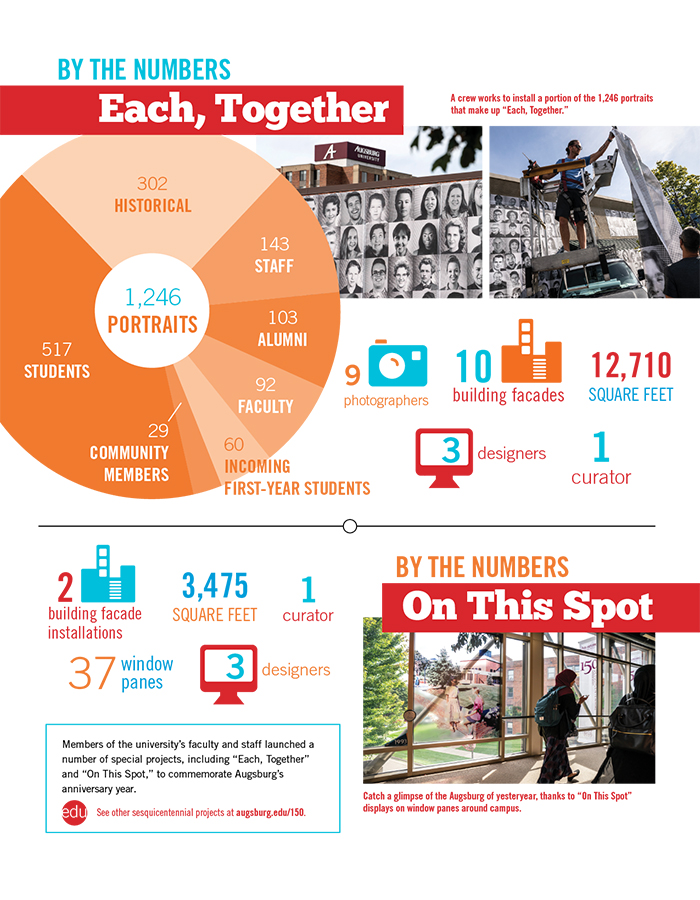
This idea is at the core of new art and historical exhibits that cover collectively four city blocks on 12 of Augsburg’s building facades and 37 window panes around campus. As part of Augsburg’s sesquicentennial celebration, artists and designers at the university wanted to give the community a chance to reflect on their history and their people. So the works, dubbed respectively “On This Spot” and “Each, Together,” bring into focus the history of the campus and the surrounding neighborhood, and the people who are the Augsburg of yesterday, today, and tomorrow.
‘Humans at the center’
“Each, Together,” the larger of the two projects, is a Group Action of the international “Inside Out: The People’s Art Project” initiative that launched in 2011 after a French street artist, known only as JR, won that year’s TED Prize. First awarded in 2005, the TED (Technology, Entertainment, and Design) Prize has become synonymous with visionary thinking meant to spark change throughout the world. Winners of the award—including educators, artists, chefs, journalists, and even former President Bill Clinton—have used the $1 million prize to fuel specific community projects, like healthy food initiatives and educational innovations. The winning projects all have one thing in common: They are designed to make people engage in their communities.
 In the case of artist JR’s project, his vision was to create works that “shine a light on the unsung and give everyone the dignity they deserve.” And he hoped that beyond his capacity as one artist, people around the world would join in the celebration of others. To date, more than 260,000 people in 129 countries have participated in different versions of the project featuring faces displayed on billboards, buildings, sidewalks, and in digital collections. Augsburg is one of the latest communities to answer the call.
“We saw that invitation, that there was a related, common ethos to what we have here at Augsburg, and that the project was similar to public works we’ve done here,” said Christopher Houltberg, Augsburg associate professor of art and design. “It’s really about putting humans at the center.”
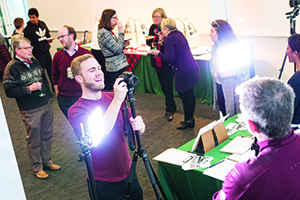
So a team that included a curator, nine photographers, and three designers—Houltberg, Maggie Royce ’15, and Indra Ramassamy ’18—worked for several months between Fall 2018 and Summer 2019. The photographers attended between 15 and 20 campus events, all working to capture as many faces as possible to best tell the Augsburg story.
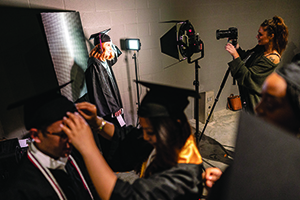 “The way we went about it was really organic,” Houltberg said. “We started going to events around campus in Fall 2018 and then in the springtime, trying to get to as many different ones as possible. There’s a really big holiday event called Advent Vespers, and a lot of alumni come to that.” All told, the group took more than 900 photos and gathered about 300 additional images of historic Auggies.
“It’s very democratic; everyone is given the same amount of space,” Houltberg said. “From our president, Paul Pribbenow, to people who work on our janitorial staff, to our students, to our former mayor, R.T. Rybak.
“As we were defining the parameters [of the ‘Each, Together’ project] it was a fun surprise for us to see who self-identified as part of Augsburg.”
Bigger dose of Augsburg
R.T. Rybak, current president of the Minneapolis Foundation, was the mayor of Minneapolis from 2002 to 2014. He said it would be impossible to think of the growth and development of the city without considering the role Augsburg has played in that history.
“I’ve conservatively said 1,000 times in public speeches that the neighborhood where Augsburg is, is our Ellis Island. One wave after the other washes in and the next wave builds on top, and it’s something that no one wave could have created in isolation,” Rybak said.
That’s most certainly the story of the Cedar-Riverside neighborhood that surrounds Augsburg and the story of Minneapolis as a whole.
“… I often think we just need a bigger dose of Augsburg. We need to realize that offering that ladder of opportunity to someone else makes all of us able to climb higher. We are better together.
—R.T. Rybak, former Minneapolis mayor
“Augsburg is a shining example of the very best parts of Minneapolis’ history. The university represents opening doors to people with strange names like Johnson or Anderson or Rybak, and keeping those doors open for people with names that come from Africa, Asia, and places across the globe.
“When I get down about what’s fracturing our deeply divided country and world today, I often think we just need a bigger dose of Augsburg. We need to realize that offering that ladder of opportunity to someone else makes all of us able to climb higher. We are better together.”
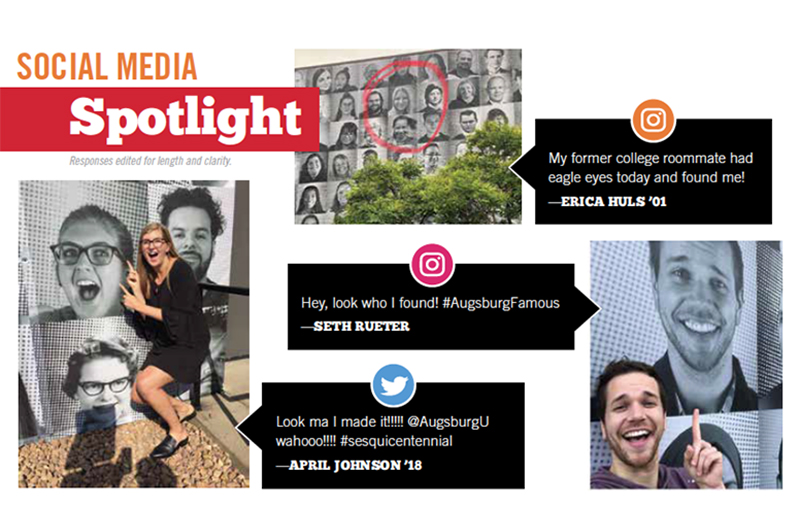
Houltberg said the “together” ideal is at the heart of the exhibit. “As individuals we are showing up, and collectively we can do something greater than what we can do on our own,” he said. “I loved seeing the portraits blocked together, seeing people stop and take selfies. There are people who say, ‘I recognize who that is!’”
Forward facing, historic reflections
Kristin Anderson, a co-creator of these projects as well as a professor of art history and Augsburg archivist, said she’s only heard good things about the exhibit.
“I have seen emails and tweets—sometimes emotional—with people responding to the wall as a whole, as well as to their individual images,” Anderson said.
The community is responding to the historical revisit that “On This Spot” installations provide, too, she said.
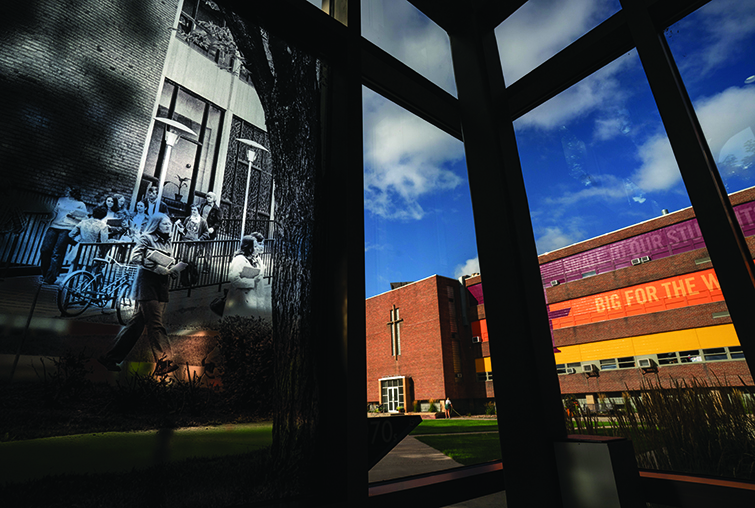
That exhibit features enormous panels that share Augsburg moments that photographers captured decades ago. The campus life of yesteryear includes images of young bobby soxer women from the 1940s in saddle shoes and flowing skirts in contrast with men wearing formal suits while tramping across a snow-covered campus.
“It has been a fun way to bring some old photographs to life and to show how the campus is layered on the site. Those ‘lost’ buildings displayed on the walls of the current buildings help to connect us to our past, reminding us of the imagination and commitment of our predecessors,” Anderson said.
The two exhibits are being admired by community members who see the campus regularly and by those who keep up with Augsburg from a distance.
Killa (Martinez Aleman) Marti ’08 came to Augsburg from her home in Honduras. Marti said she brought her own values with her when she enrolled, “but Augsburg put them to work. The Auggie community showed me that I wasn’t crazy to want a career with meaning.”
“Those ‘lost’ buildings displayed on the walls of the current buildings help to connect us to our past, reminding us of the imagination and commitment of our predecessors.”
—Kristin Anderson, university archivist
 For Marti, “Each, Together” perfectly sums up her experience at Augsburg.
“My career is an intersection of what I love to do with the opportunity to serve,” said Marti, an attorney in Atlanta. “To think critically, to be socially and community-minded—all of the things I exercise in my life were supported and further developed at Augsburg.”
Houltberg said it’s difficult not to consider the greater impact that art, especially a work like “Each, Together,” has.
“Having a group of artists, designers, and photographers come together to make something this beautiful and to see it up and fully functioning is pretty great,” he said.
“It has created a tangible thread between all of us, which transcends 150 years and all our history,” said Ramassamy, who worked with the team to design “Each, Together.”
“We live in a visual world yet we can be unaware of each other,” she said. “This project is making us aware of one another, making us pay attention, making us curious about the person in the portrait above or to the left or right of us.”
“I love watching people who are walking down the streets looking at the portraits,” Houltberg said. “There’s an element of surprise to it that’s really fantastic. Sometimes the tendency is to put people in big groups. But if you look at these portraits, look at the eyes, and look at the humans who are represented here, you see just how wide a spectrum of humans we are. Anytime we can show the humans and not the institution, we win.”
Social Media Spotlight
You Might Also Like

Can a smartphone app de-escalate traffic stop encounters between drivers and police?
- on August 20, 2021
The Auggies who refuse to ‘keep politics off the field’
- on August 20, 2021